How to Choose an Automatic Transfer Switch (ATS)
Choose the right automatic transfer switch: PC class vs CB class, transfer time, pole count and current rating for generator and backup power systems.
Read More

A surge protective device (SPD) is the one component in a distribution board that spends its entire service life waiting for something that may only happen a few times a year. When a transient overvoltage does arrive, the SPD has microseconds to clamp the voltage and divert the energy somewhere harmless. Choose the wrong one and you find out during the storm, not before it.
This guide explains the difference between Type 1, Type 2 and Type 3 SPDs, how AC and DC surge protection differ, and how to work through the ratings that actually decide whether a device will hold up. It is written for panel builders, installers and buyers specifying protection for commercial, industrial and solar PV installations.
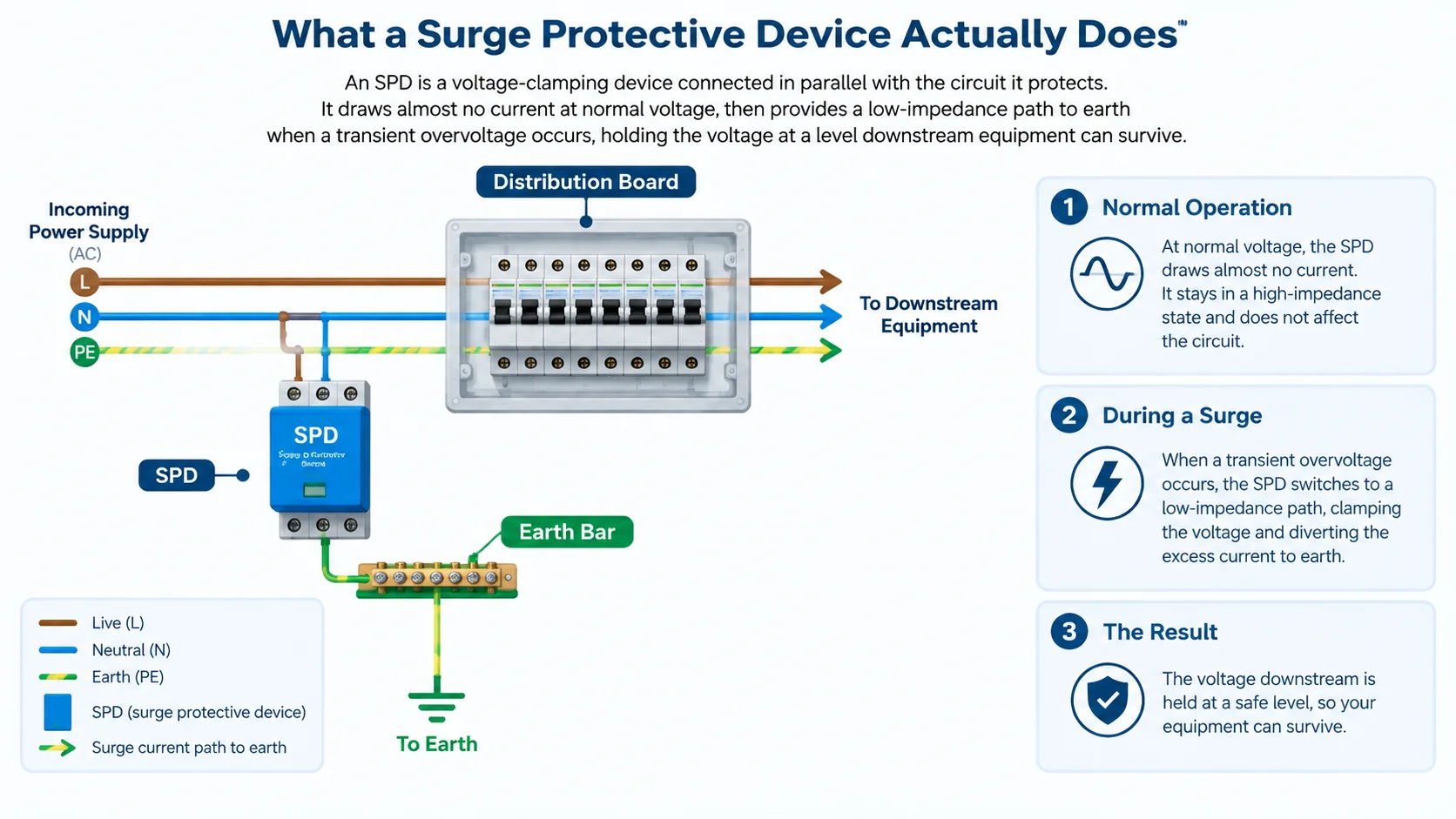
An SPD is a voltage-clamping device connected in parallel with the circuit it protects. Under normal operating voltage it is effectively invisible — it draws almost no current. When the system voltage rises above a defined threshold, the device’s internal components change state and provide a low-impedance path that diverts the surge current to earth, holding the voltage at a level the downstream equipment can survive.
Two numbers describe that job. The first is how much surge current the device can discharge before it is destroyed. The second is the voltage protection level (Up) — the residual voltage that still reaches your equipment while the SPD is conducting. A device with a huge discharge capacity but a high Up can still leave a sensitive drive with damaged electronics.
The IEC 61643 classification describes where a device is installed and what kind of surge energy it is expected to handle. The three types are not competing options; they are stages in a cascade.
| Feature | Type 1 SPD | Type 2 SPD | Type 3 SPD |
|---|---|---|---|
| Main role | Lightning current discharge | Distribution-level surge limitation | Final equipment protection |
| Typical location | Main incoming panel | Main or sub-distribution board | Close to the terminal load |
| Test class | Class I | Class II | Class III |
| Principal test waveform | 10/350 µs | 8/20 µs | Combination wave |
| Key current rating | Iimp | In and Imax | Uoc |
| Typical surge environment | Partial lightning current | Induced lightning, switching surges | Residual surge voltage |
A Type 1 SPD is installed at the origin of the installation, usually at the main incoming panel. It is tested with a 10/350 µs waveform and rated by Iimp, the impulse discharge current it can carry per protection mode. Its job is to discharge partial lightning current entering through an external lightning protection system or an overhead supply line.
A Type 1 device is normally required when the building has an external lightning protection system, or when a lightning risk assessment performed to IEC 62305 concludes that direct strike current may be imposed on the installation. Buildings without such exposure usually begin the cascade with Type 2 instead.
One limit is worth stating plainly: a Type 1 SPD manages high-energy current, but it does not automatically guarantee a low residual voltage at every remote load. That is why downstream stages exist.
The Type 2 SPD is the most commonly specified surge device in low-voltage installations. It sits at main distribution boards, sub-distribution boards, machine control cabinets and solar inverter AC panels, and it handles the surges that actually occur most often: induced lightning effects, switching operations, motor and transformer switching, and utility network disturbances.
Type 2 devices are tested with the 8/20 µs current waveform and rated by In (nominal discharge current) and Imax (maximum discharge current). Both values must be read together with their waveform — a kA figure on its own tells you nothing useful.
For a building without external lightning protection and with an underground incoming supply, a correctly sized Type 2 at the origin is often the reasonable starting point. This is not a universal rule; final selection should follow the applicable installation standard and a project-specific risk assessment.
A Type 3 SPD protects individual sensitive loads: PLCs, servers, control systems, communication equipment, medical devices and precision power supplies. It is evaluated with a combination-wave generator producing a 1.2/50 µs open-circuit voltage and an 8/20 µs short-circuit current, and rated by Uoc.
A Type 3 device cannot discharge the high surge energy present at a service entrance. It is terminal protection within a coordinated system, never a substitute for upstream protection.
Effective surge protection is a cascade, not a single device. Each stage removes part of the energy and lowers the residual voltage the next stage has to handle.
Skipping a stage leaves a gap. Installing Type 1 and Type 3 while omitting Type 2, for example, leaves the distribution level unprotected and forces the point-of-use device to absorb energy far beyond its rating. When two SPDs are used in series, they must also be coordinated in energy terms — either by the manufacturer’s coordination table or by a specified decoupling length between them.
Solar PV systems need dedicated DC surge protection, and this is where specification mistakes are most common. A DC arc does not self-extinguish at a current zero crossing the way an AC arc does, so a device designed for AC duty cannot simply be reused on a DC string.
| Consideration | AC SPD | DC / PV SPD |
|---|---|---|
| Uc rating | Matched to system voltage, e.g. 275 V or 385 V | Matched to string voltage, e.g. 600 V, 1000 V or 1500 V DC |
| Arc behaviour | Self-extinguishing at current zero | Requires dedicated DC arc management |
| Typical installation points | Main board, sub-board, control panel | String side and inverter DC input |
| Pole configurations | 1P, 2P, 3P, 4P plus NPE | 2P, 3P typically, per string polarity |
In a PV installation, DC SPDs are normally fitted on both the string side before the combiner box and at the inverter DC input, while AC SPDs protect the inverter’s AC output and the downstream distribution. Where long DC cable runs are exposed to lightning, both ends may need protection.
Once you know which type you need, these are the parameters that determine whether a specific part number is correct for the job.
A correctly specified SPD can still underperform because of how it was installed. The most common problems are predictable.
| Mistake | Consequence | Correct approach |
|---|---|---|
| Long connecting leads | Inductive voltage drop raises the effective protection level | Keep connecting leads as short and straight as practicable, ideally under 0.5 m total |
| Wrong type at the service entrance | Device destroyed during a direct strike event | Match Type 1 duty to installations exposed to partial lightning current |
| No upstream backup protection | Failed SPD becomes a fault or fire risk | Install the specified fuse or breaker per the datasheet |
| AC device used on a DC string | Sustained DC arc, device failure | Use a DC-rated SPD with the correct Uc for the string voltage |
| Ignoring the status indicator | Protection silently absent after one event | Use devices with status indication or remote signalling for critical loads |
SPDs are consumable protective components. Each surge event consumes part of their absorption capacity, and the device degrades progressively. Most quality units include a mechanical status window that changes colour when the internal element has reached end of life, and higher-end models add a remote signalling contact so a BMS or monitoring system can flag the condition.
For critical installations, inspect SPD status indicators after any significant storm event, and include them in the routine maintenance schedule alongside the rest of the protection scheme. A device that has quietly failed offers exactly the same level of protection as no device at all.
A Type 1 SPD handles partial lightning current at the origin of the installation and is tested with a 10/350 µs waveform, rated by Iimp. A Type 2 SPD handles induced and switching surges at main or sub-distribution boards, is tested with an 8/20 µs waveform, and is rated by In and Imax. Many installations need both as part of a coordinated cascade.
No. A Type 3 SPD is only necessary where sensitive equipment — drives, PLCs, control electronics — needs fine protection close to the load. It complements but never replaces Type 1 or Type 2 protection.
Yes. PV arrays present long exposed conductor runs that are efficient at picking up induced surges, and the DC side requires dedicated DC-rated SPDs. Protection is typically applied on the string side and at the inverter DC input, with AC protection on the inverter output.
There is no fixed interval. Replacement is driven by the status indicator and by inspection after significant surge events. Devices with remote signalling make this manageable at scale; without it, physical inspection is the only reliable method.
Not by itself. Discharge capacity determines how much surge energy the device can absorb, but protection quality is set by the voltage protection level (Up) relative to the equipment’s withstand rating. A large capacity device with a poor Up protects less well than a smaller device with a lower Up.
IEC 61643 covers the devices themselves, including test classes and rating definitions. IEC 62305 covers lightning protection risk assessment and where Type 1 protection is required. Local wiring regulations may add further requirements.
Specifying surge protection well comes down to three decisions: identify the surge exposure at each point in the installation, choose the matching SPD type and stage, and verify that every rating clears the equipment it protects. Get those right and the rest of the specification follows.
If you are building a coordinated scheme and need to compare AC and DC options, you can review the surge protector range for DIN-rail AC and photovoltaic DC devices, or check the 4-pole CSPD-125 surge protective device for three-phase main board applications. For PV installations specifically, the 600 V and 1000 V DC SPD is rated for string-side and inverter-input protection.
Need help matching an SPD to your system voltage, fault level and configuration? Send us the system details and we will confirm the correct type, pole count and backup protection.